
Desktop / Local
The program runs on your own computer.
- Windows desktop
- Works without internet
- Single-file database
- One-time licence
Own your management, not your software.
Built around Turkish condominium law, so a resident can take the manager’s job without a finance or legal background. You work on your own computer; your owners read their own account in a browser, in their own language.
No card required. No mandatory subscription.
Quorum, voting limits, notice periods, expense allocation, the annual operating plan and the late-payment charge follow Turkish condominium law. You make the decisions; the software keeps the procedure straight.
The database is one file on your own computer. Copy it, back it up, move it to another machine. Export to Excel, SQL or a full backup at any time — export keeps working even after a licence expires.
The management side is in Turkish, because the law is Turkish. The resident portal speaks English, German, Russian and Turkish, so an owner abroad reads their own account in their own language.
Pick the one that fits your building — and change your mind later.
The program runs on your own computer.
Desktop plus the resident portal we host.
The portal on your server, your domain.
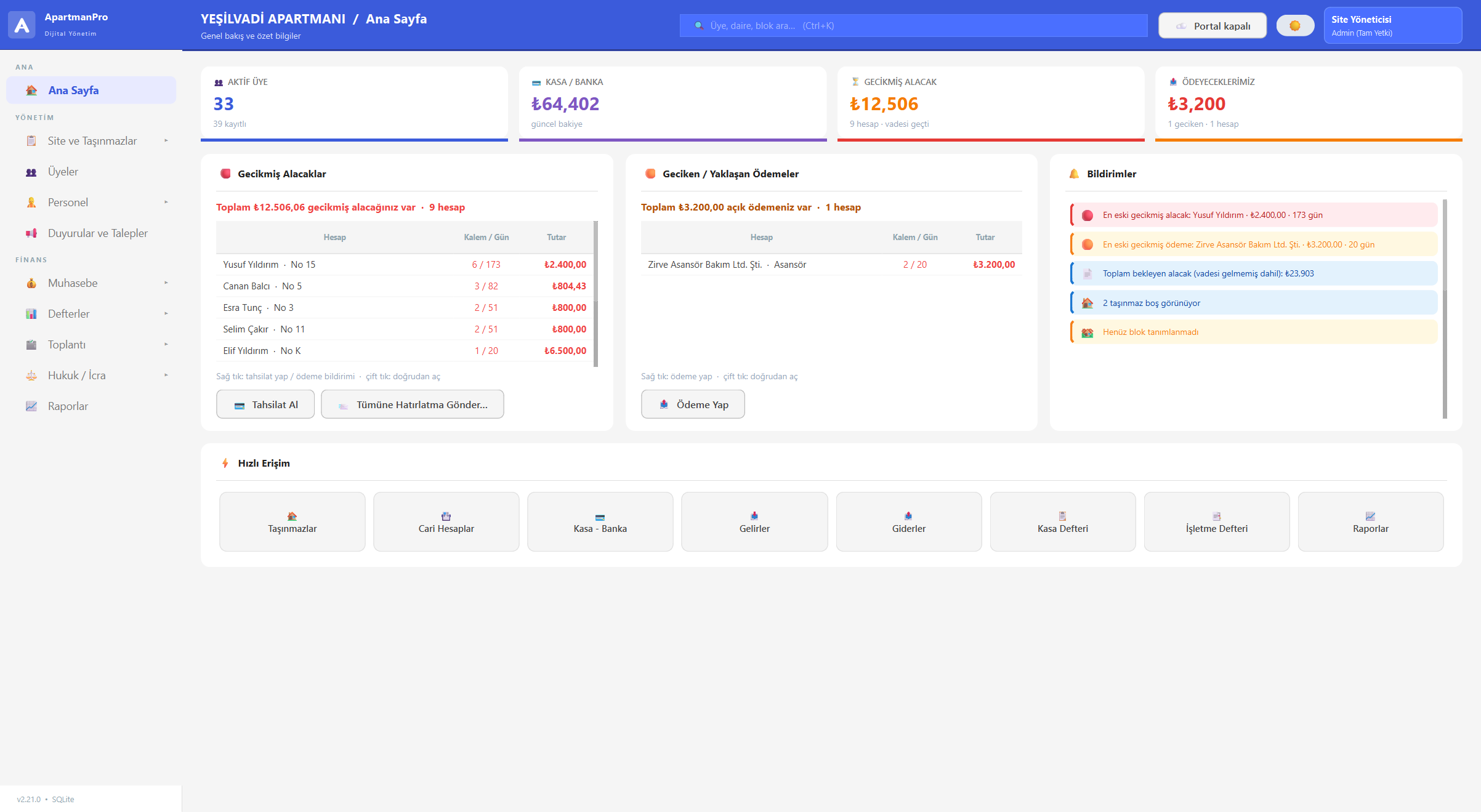
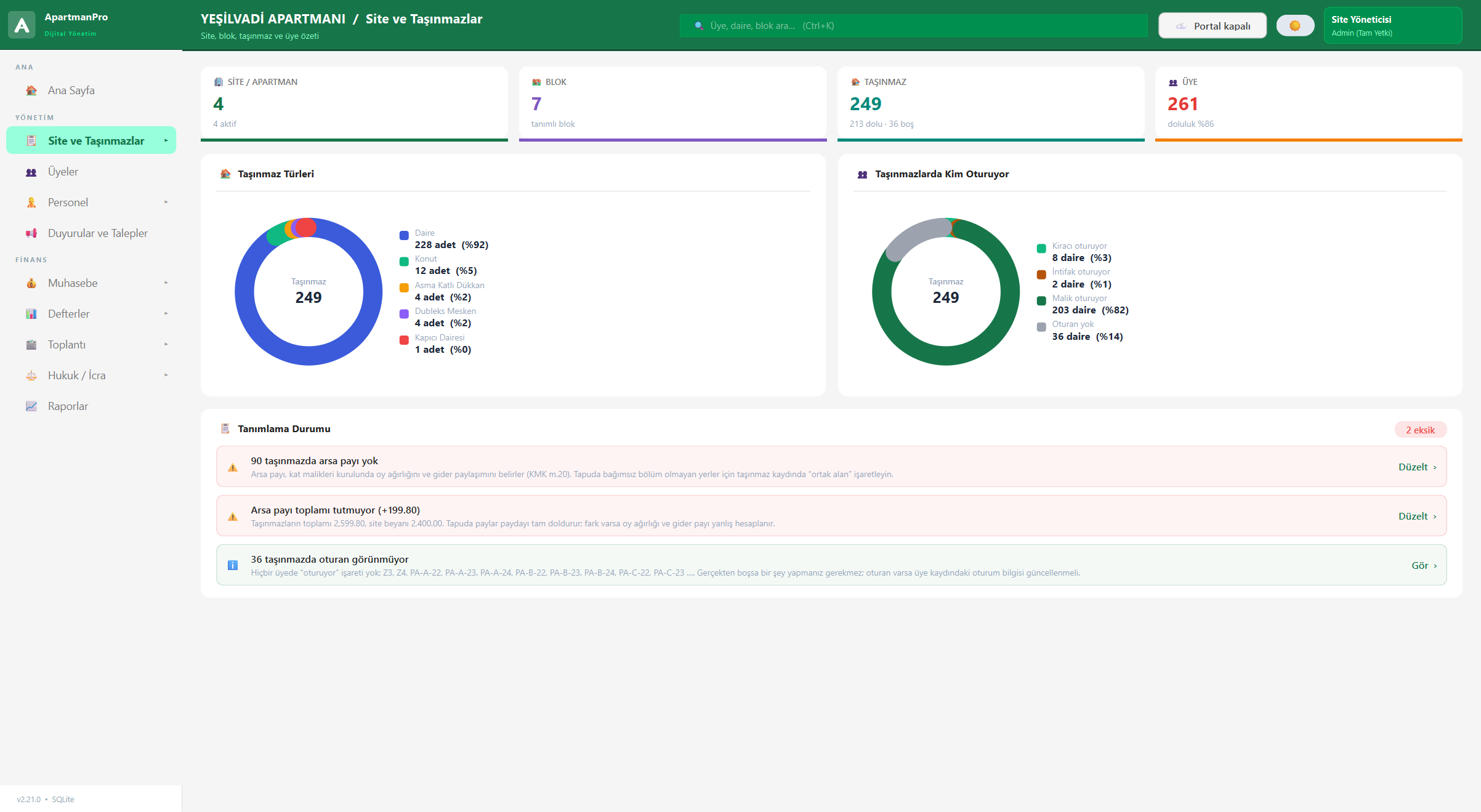
Every screen below is the real program, captured from a sample building — not a drawing. The management program is in Turkish, because the law it implements is Turkish; the resident portal is in English, German, Russian and Turkish.
Overdue accounts, the next meeting and notifications on one screen.
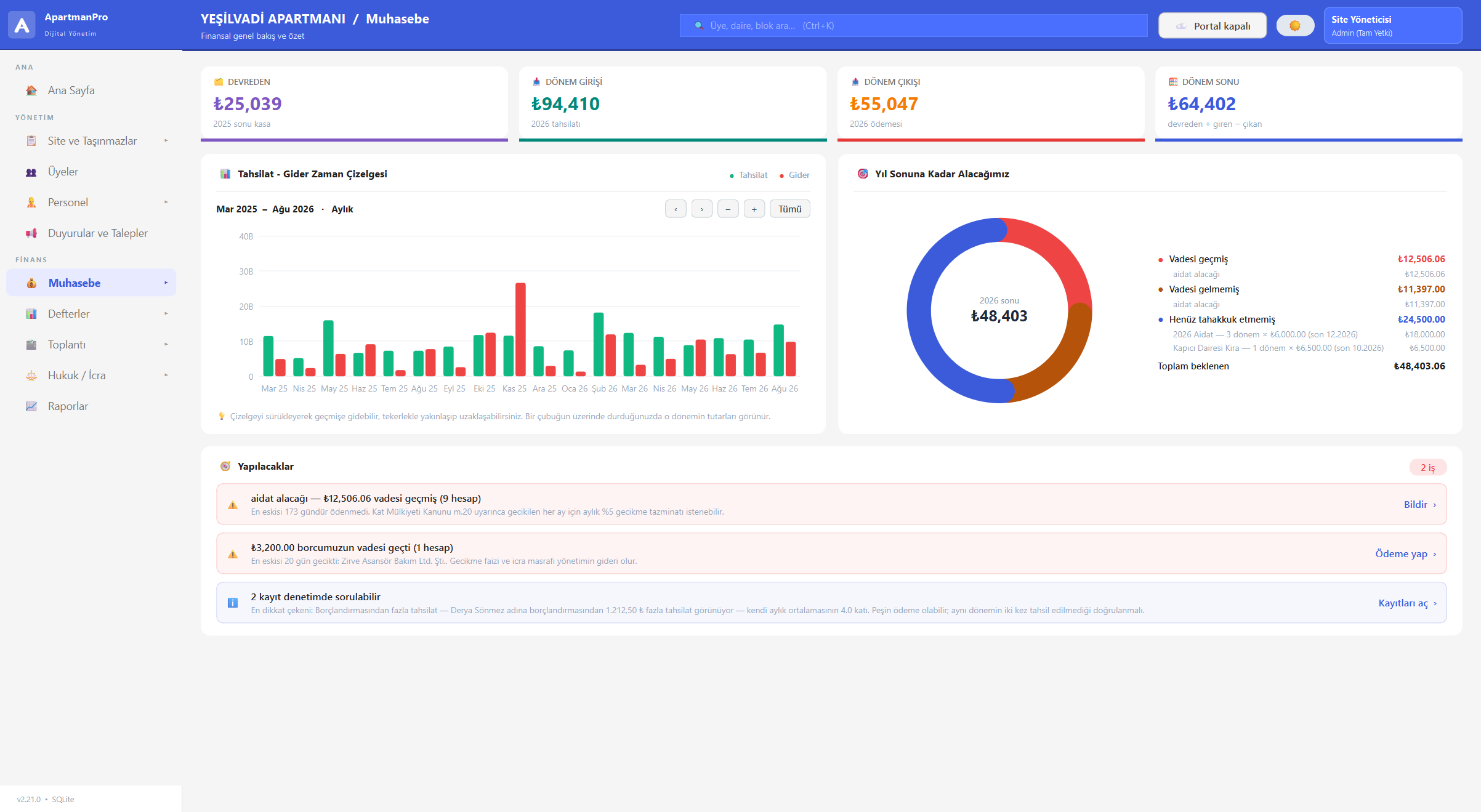
Charges, collections, expenses, cash, bank and supplier accounts.
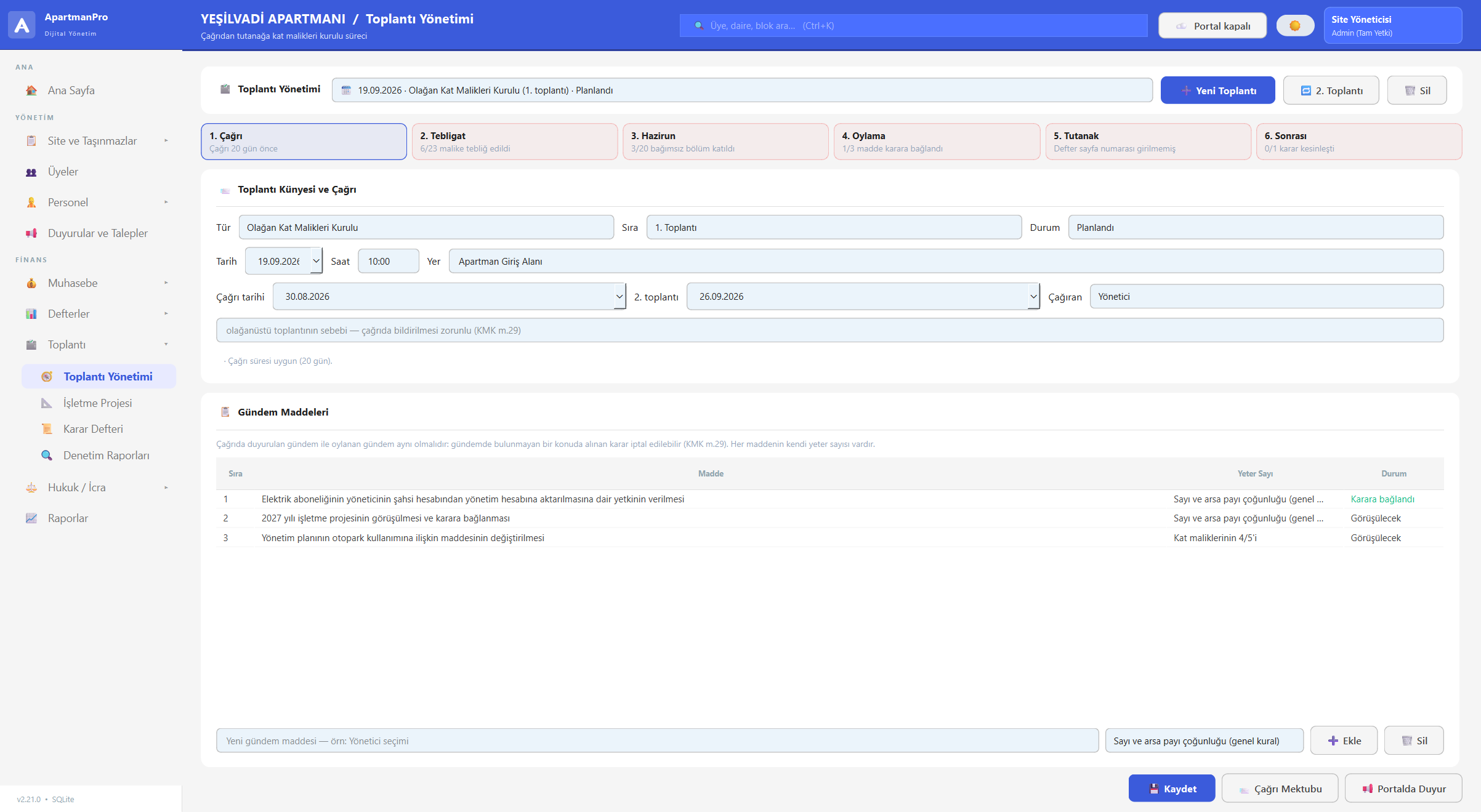
From the notice to the minutes, from the decision book to announcements.
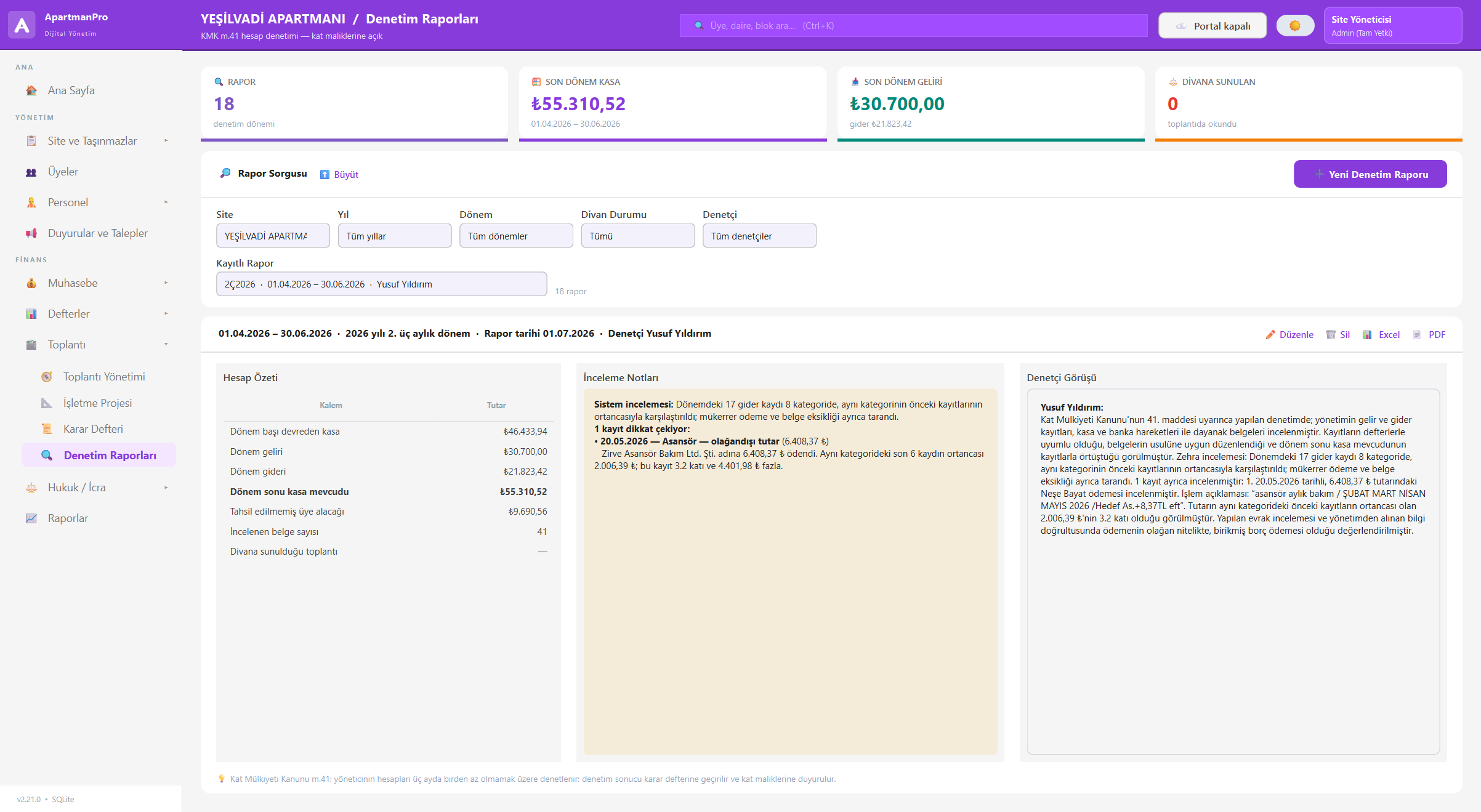
Cash reconciliation, the records the automatic review flagged, auditor’s report.
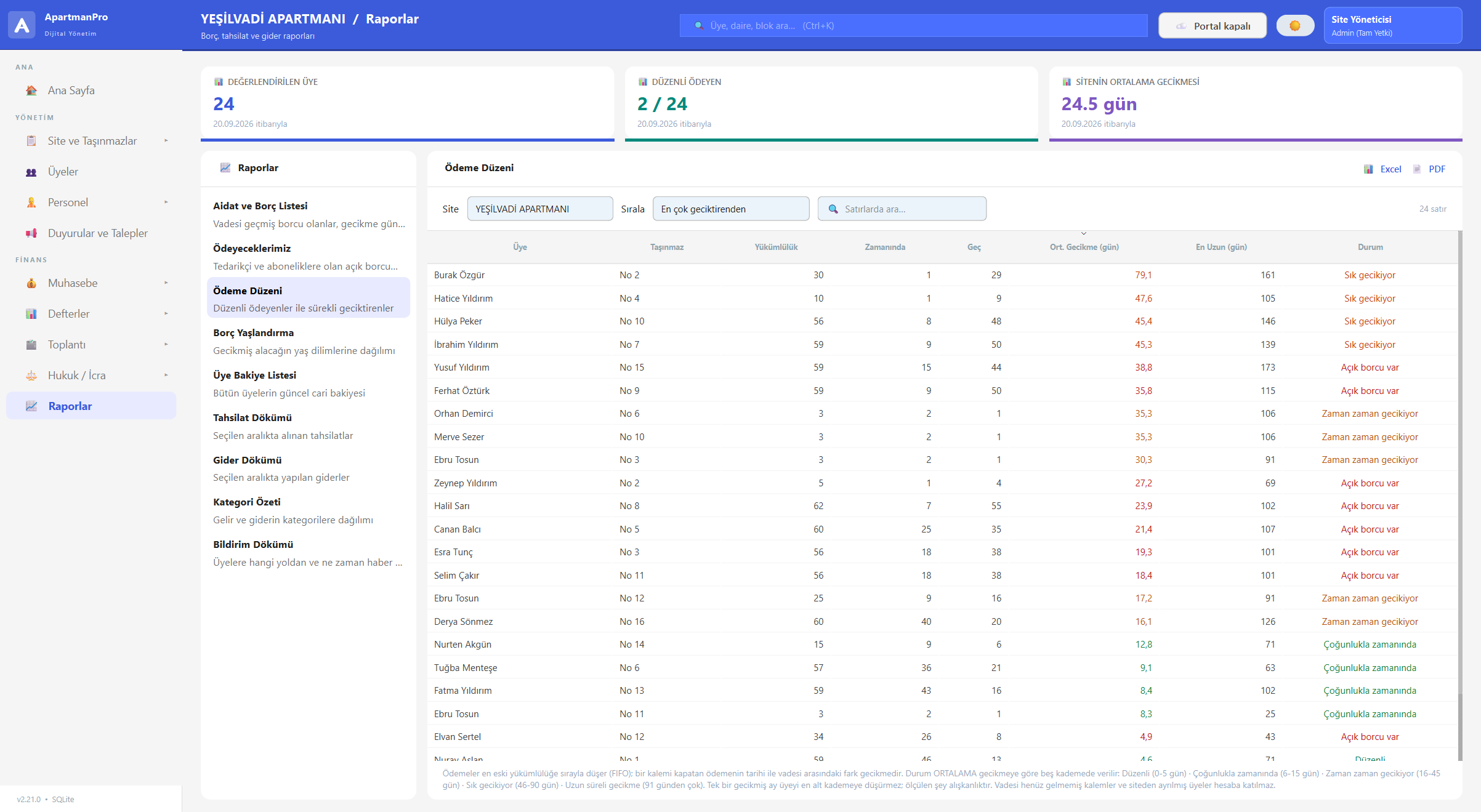
Payment behaviour: who pays on time and who is chronically late.
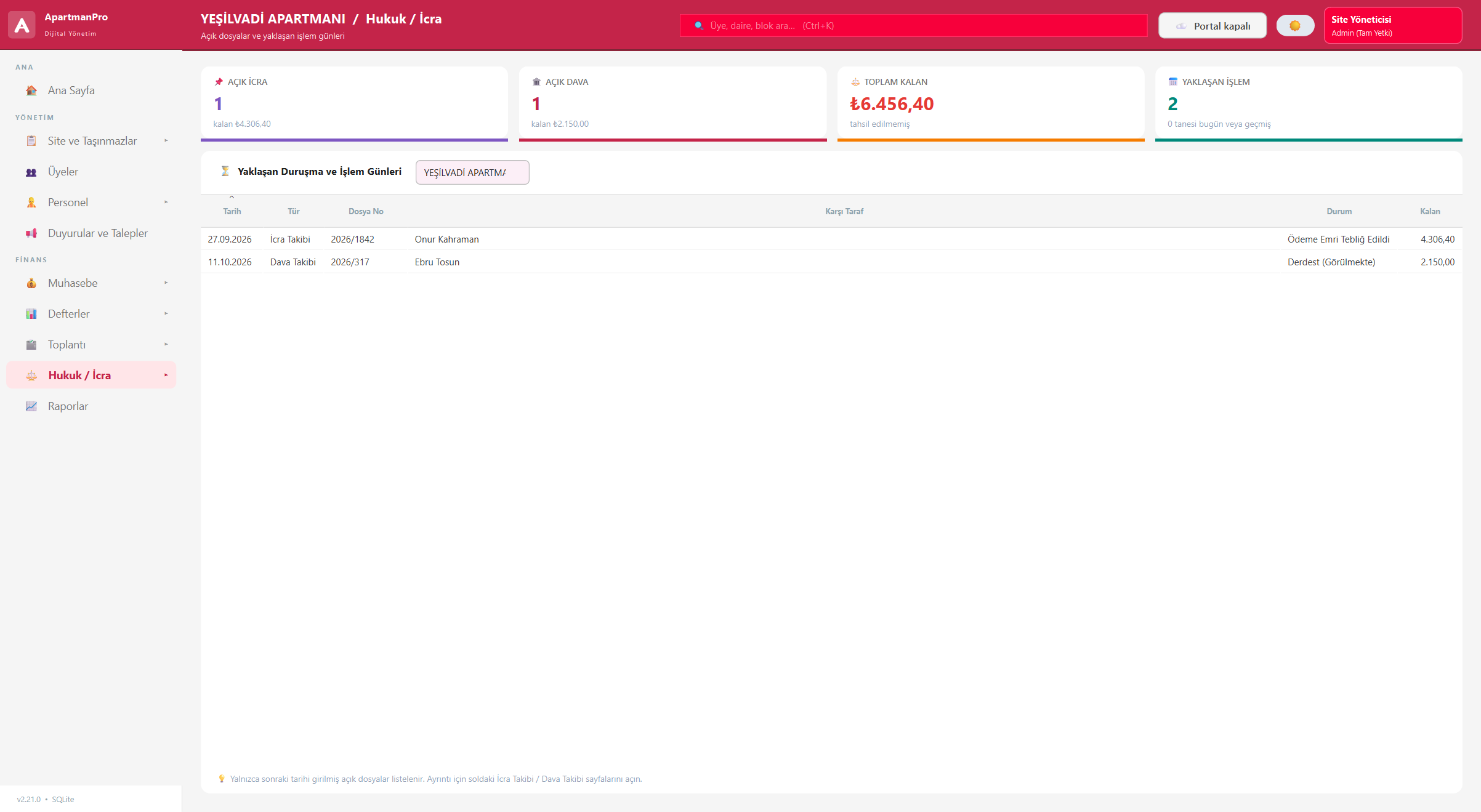
Enforcement files, upcoming deadlines and the law firms you work with.
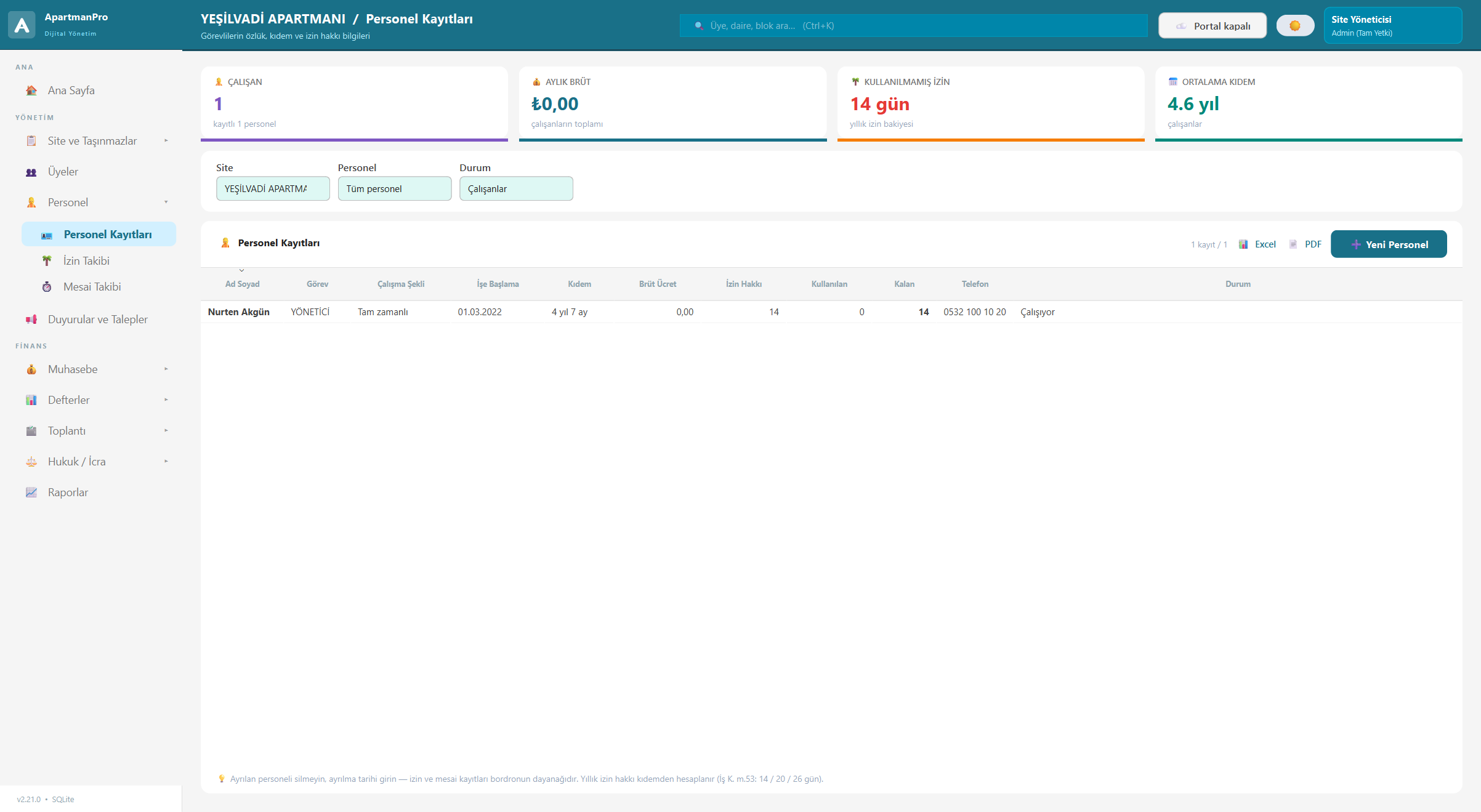
Caretaker and staff records: employment, seniority, leave and overtime.
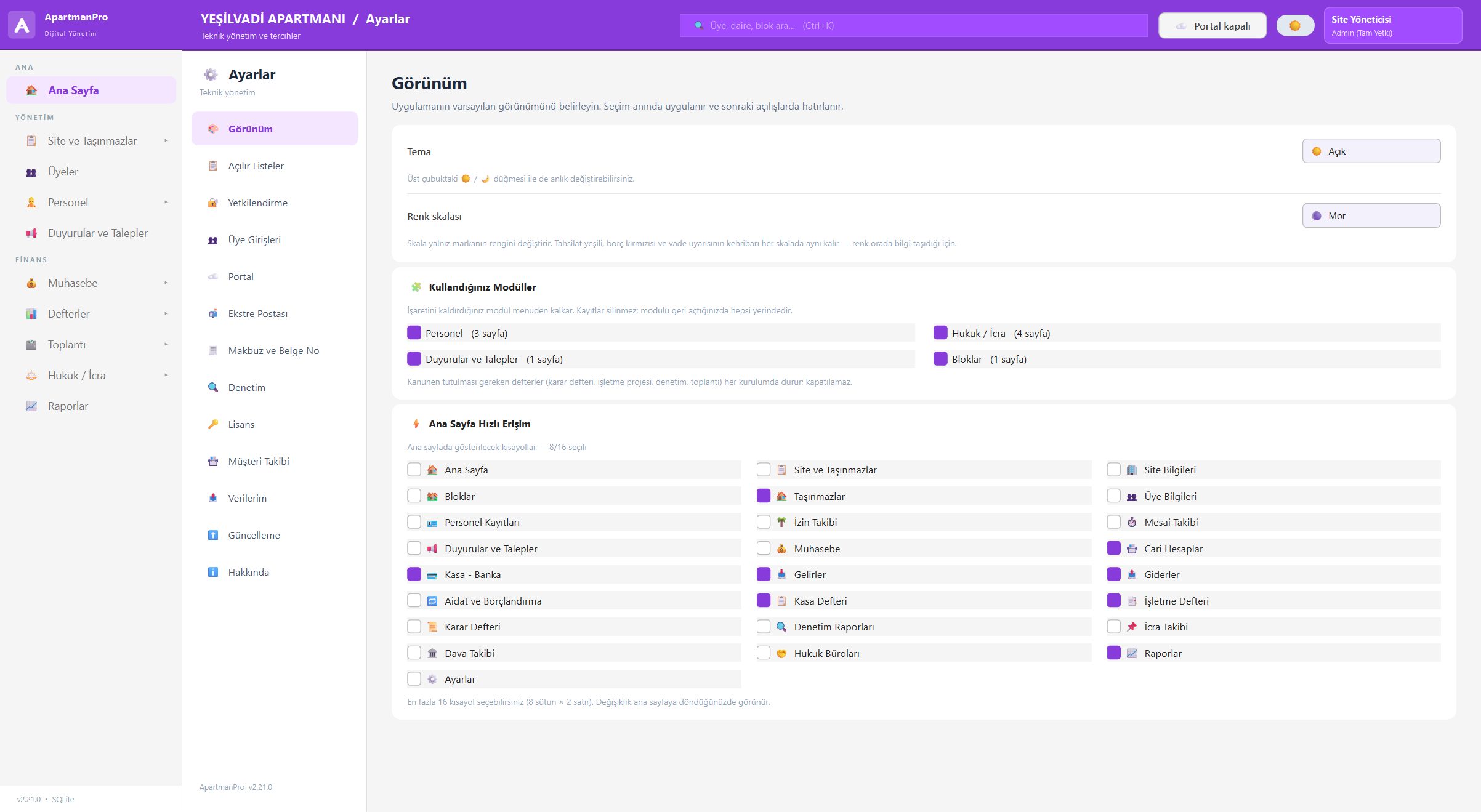
Theme and colour, the modules you use, your home-screen shortcuts.
The whole job of running a building, in one system.
Every step money takes — charge, collection, expense, cash, bank, supplier account — in one ledger. Bank statements are reconciled here too.
Blocks, units, owners, tenants and usufructuaries; land share and who actually lives there. Expense allocation is read from this structure.
Notice, service, attendance, quorum, minutes and the decision book. The annual operating plan is prepared in the same place.
Period figures and an automatic review are handed to the auditor; the opinion field is deliberately left empty.
Caretaker and staff records, employment contracts, leave and overtime.
Overdue accounts, the statutory late-payment charge and the documents enforcement proceedings require.
Debt, collection, expense and category breakdowns. The Payment Behaviour report ranks owners across five bands, from “pays on time” to “chronically late”, with average and longest delay per owner.
The program adapts to you: light or dark theme and six colour schemes, modules you do not use removed from the menu, the shortcuts on your home screen, drop-down lists, receipt and document numbering, permissions. Books the statute requires cannot be switched off.
The records live on the manager’s desktop. Owners, the auditor and the manager each see them from their own phone, as far as their role allows.
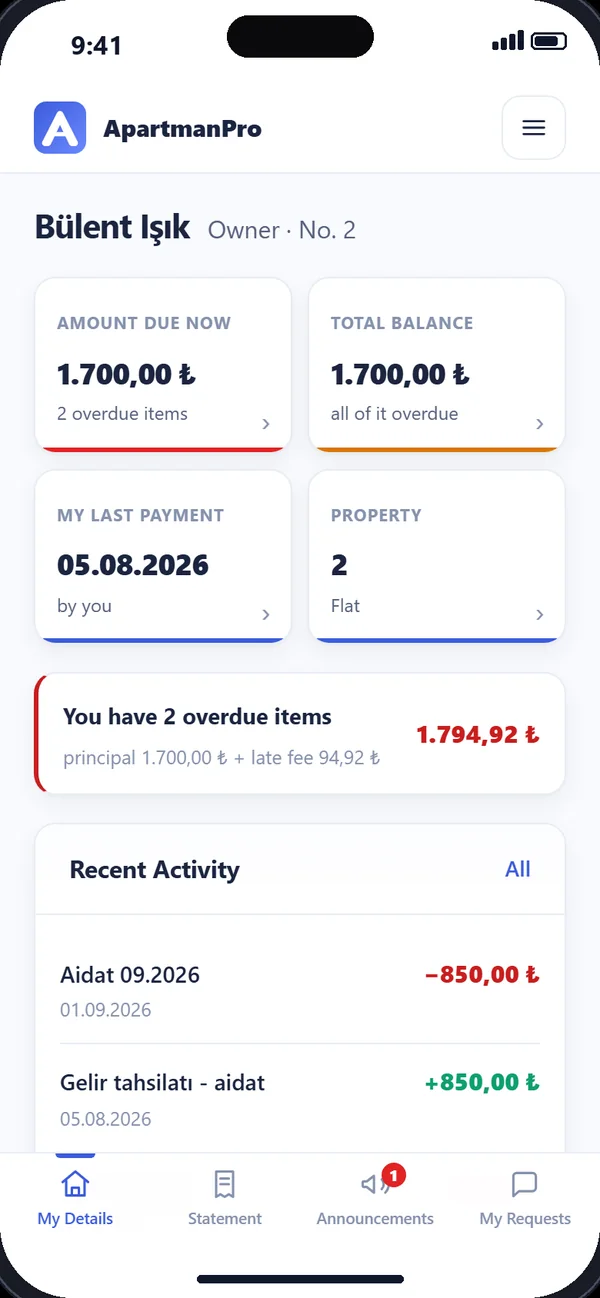
Sees what is owed, what was paid and every announcement; replies to notices and opens requests — in their own language.
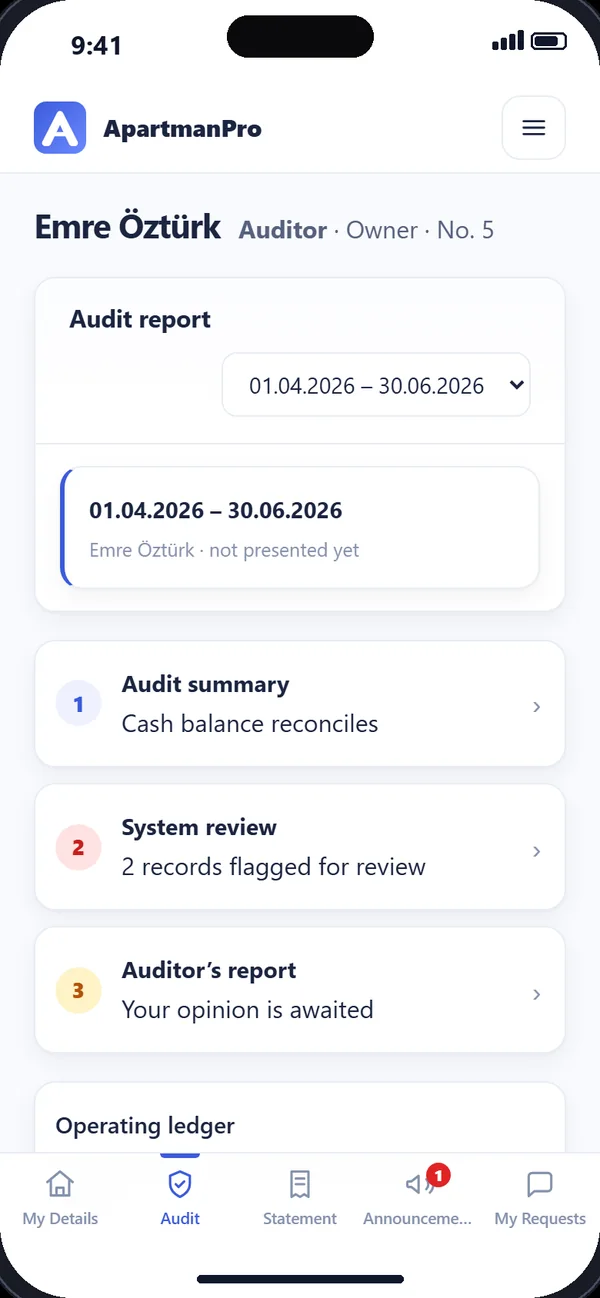
Reviews the period summary and the records the system flagged, reads the ledger for any date range and drafts the report from a template. The opinion stays theirs.
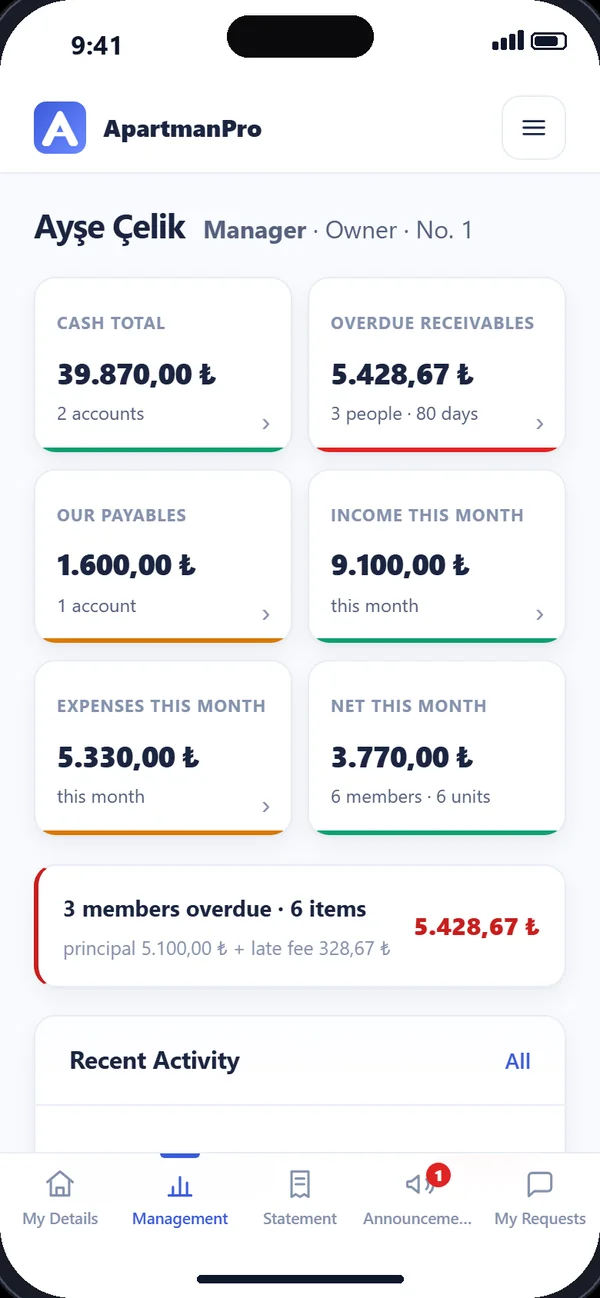
Cash on hand, this month’s income and spending, who is overdue and for how long. Watches the building from the phone; entries are made on the desktop.
Nothing to install: it opens in the browser. On a phone it can be installed like an app, and announcements arrive as notifications.
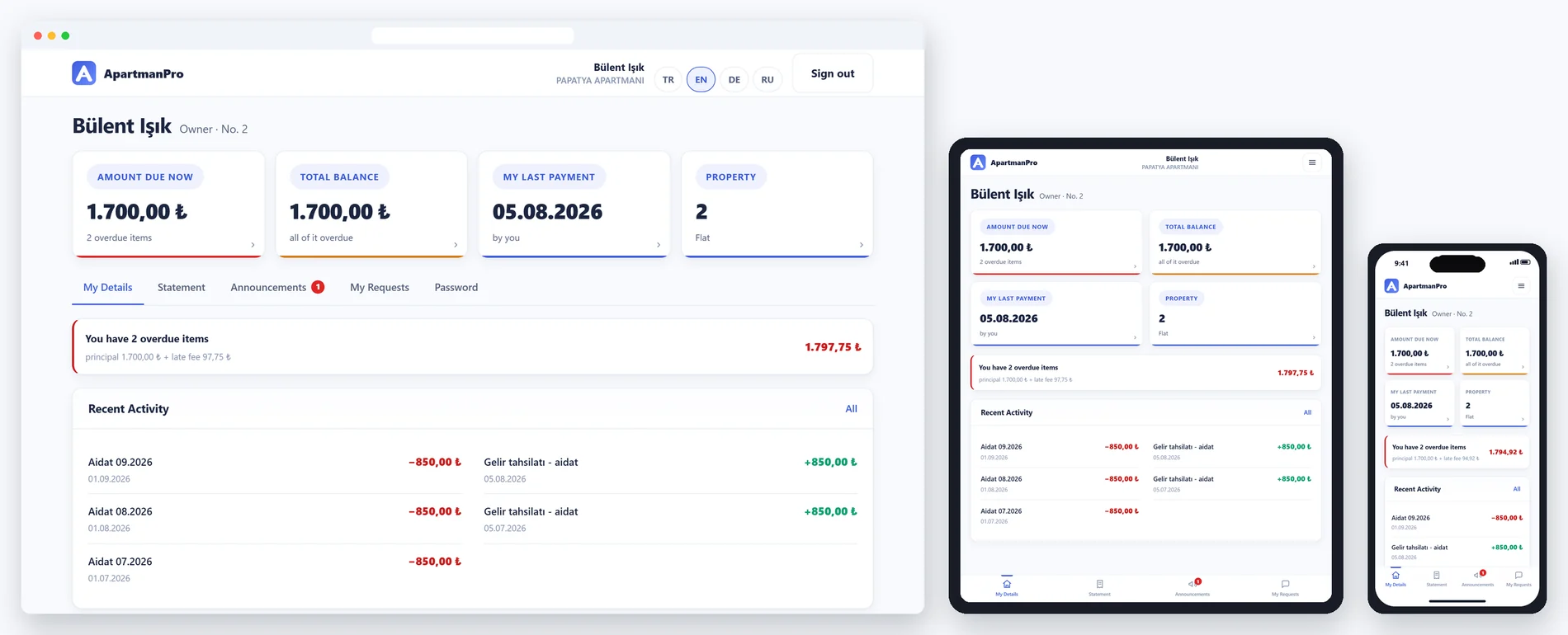
Real portal screens, captured with sample data. The four languages apply to the portal; the desktop program is in Turkish. Announcement and request text appears in the language your management wrote it in.
A meeting is the easiest thing in building management to get wrong — and a decision taken at an invalid meeting can be set aside. The program walks the whole process in six steps and tells you, at each one, what the law requires and what is still missing.
Enter the meeting date and the program works out the latest date the notice can go out, warning you if there is not enough time. It also proposes a compliant date for the second meeting.
At least 15 days’ notice
Who was called, who received it, who signed — in one table. Owners who do not live in the building are served at their registered address; the portal announces it too, with a phone notification.
Tick off who is present and the quorum is calculated live, on both tests at once: number of units and total land share.
Majority of units and of land share
Each agenda item has its own threshold and the program applies the right one. One unit is one vote; where a unit is jointly owned a single representative votes; nobody may cast more than a third of all votes.
The decision text is produced together with dissenting votes and their stated reasons. Print it, have it signed, paste it into the notarised decision book — the page number is recorded too.
Service of the decision and the deadlines for challenging it are tracked. When the periods pass, the decision becomes final.
What upsets owners is rarely the amount itself — it is being taken by surprise. The operating plan screen builds next year’s budget from the trend of your past spending and the inflation you expect. Change any line by hand and see immediately what it means per unit.
Every expense line starts from its own history. One-off works — a façade renovation done in a single year — are filtered out so they do not distort the trend, and lines that started mid-year are annualised.
“What if the manager’s fee goes to 60,000?” “What if we raise the shop rent 40% in October?” Type it; the dues recalculate at once. Discard what you do not like.
If a lease renews in October, nine months are calculated at the old rate and three at the new one. Multiplying the monthly figure by twelve would delay the effect of the increase by a year.
Caretaker, boiler, gardener and watchman costs are shared equally; insurance, common-area maintenance and the manager’s fee follow land share. You can override it line by line.
Improvement and major renovation costs fall on the owner alone and cannot be added to a tenant’s dues. The program keeps the two pots apart and shows them in separate columns.
Turn the scenario you like into the plan and serve it. The seven-day objection window is tracked; with no objection the plan becomes final and carries weight in enforcement proceedings.
Before the auditor reads four hundred expense entries, the program reads them. What it flags is a pointer, not a verdict — the judgement stays with the auditor.
The opinion field is left empty on purpose — the opinion belongs to the auditor; the program prepares the figures and the findings.
Most buildings hand the job to a professional firm not because the work is heavy but because nobody feels qualified. That fear has three parts, and each of them is something software can carry.
You enter the budget; the split follows the statutory rule. Caretaker equally, insurance by land share, improvement costs not passed to tenants. The per-unit figure is right there in the list.
Notice period, quorum, voting limits and challenge deadlines are checked step by step. Anything missing is flagged before the meeting, and the minutes and attendance sheet print themselves.
The operating ledger, cash book and decision book build themselves from your entries. The auditor gets a ready report, and at handover the whole record transfers as one file.
Management companies usually charge a monthly fee per unit, taken out of the dues every month. ApartmanPro is a one-time licence with no mandatory subscription. Do the arithmetic with your own numbers — we would rather you did that than quote you a saving we cannot verify.
A flat owner running their own building, without an accounting background.
Estates with several blocks and a high unit count.
Several buildings from one program.
Checking the financial and operational state of the management.
No mandatory subscription; we do not take automatically renewing payments.
One-time licence
Ask us for pricing.
Desktop + hosted portal
Ask us for pricing.
A private setup on your server
Ask us for pricing.
Thirty days, the whole program, no card required. If it does not fit your building, you have lost nothing.
What owners and prospective managers of buildings in Turkey ask most often.
Yes. Dues, collections, expenses and cash movements are entered in plain language; the operating ledger, cash book and audit report are produced from those entries. The bookkeeping structure required by Turkish condominium law is built into the program.
Under Turkish condominium law (Kat Mülkiyeti Kanunu, article 37) the manager prepares an annual operating plan showing estimated income and expenses. ApartmanPro builds that plan from the trend of your past spending plus the inflation you expect, lets you override any line, and calculates the yearly amount and monthly advance for each owner. The plan is served on the owners and becomes final if no objection is raised within seven days.
Notice must reach the owners at least fifteen days before the meeting. The first meeting requires more than half of both the number of units and the total land share to be present; ApartmanPro shows both figures live as you tick off attendees. If the first meeting falls short, the second is held within fifteen days and no quorum is required.
Caretaker, boiler operator, gardener and watchman costs are shared equally; insurance, maintenance of common areas and the manager’s fee are shared in proportion to land share. Improvement and major renovation costs fall on the owner alone and cannot be passed to a tenant. The program applies these rules and lets you change any line when needed.
Yes. Each owner signs in to the resident portal from a phone or computer and sees their own balance, a dated statement of charges and payments, announcements and meeting notices. The portal is available in English, German, Russian and Turkish. You only ever see your own account.
Yes. The auditor signs in and reviews the period summary, the records the automatic review flagged and the operating ledger for any date range, then drafts the report from a template — the opinion stays theirs. The manager sees cash, income and spending and who is overdue. Records are entered in the desktop program, not in the portal.
The data lives in a single file on your own computer; the program does not need an internet connection to run. There is no mandatory subscription. You can export everything at any time as Excel, SQL or a database backup, and export keeps working regardless of licence status.
No. ApartmanPro implements Turkish condominium law — quorum rules, expense allocation, the statutory annual operating plan and the late payment charge all follow that statute. For a building governed by German WEG, Russian housing law or any other regime the calculations would be wrong. It is built for buildings in Turkey, including the many whose owners live elsewhere.